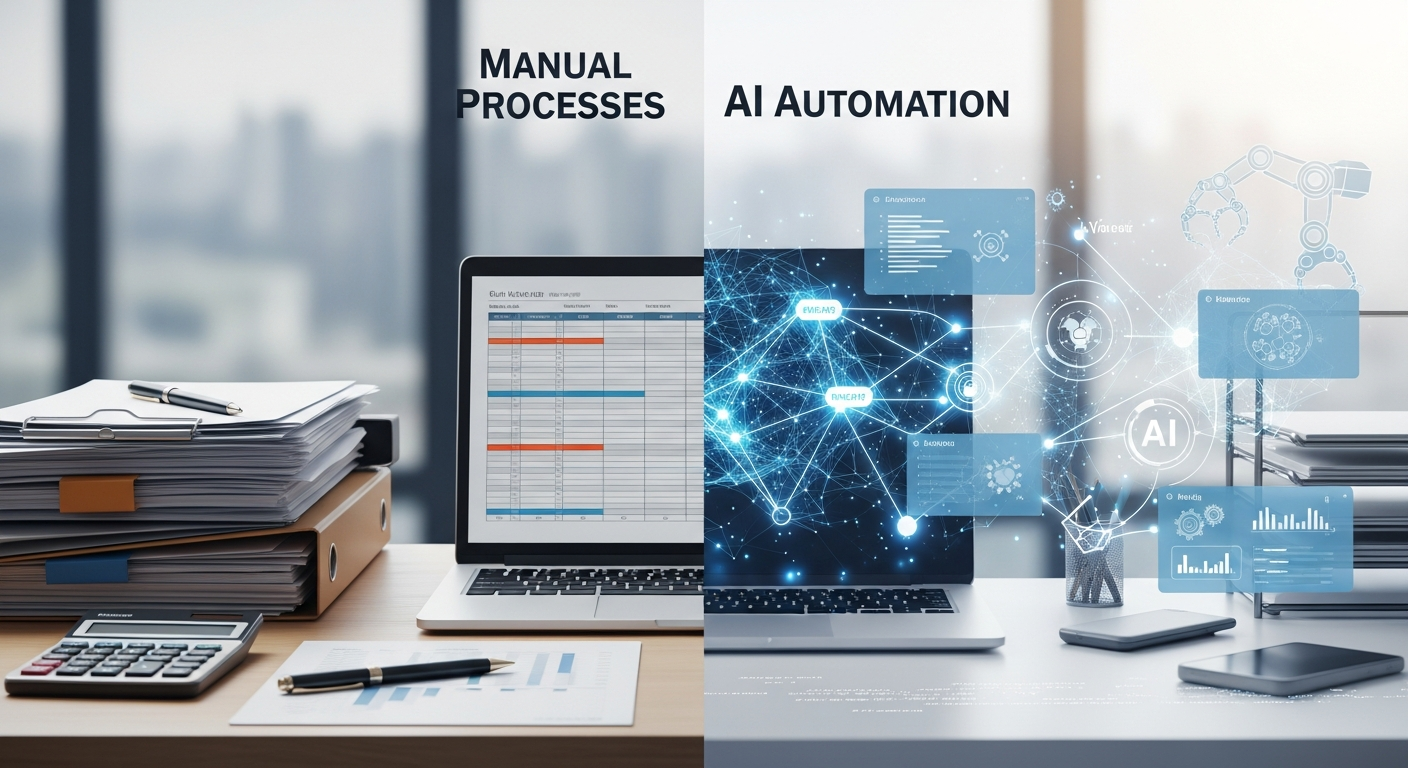
Manual Processes vs AI Automation: A Side-by-Side Cost and Time Comparison
In today's rapidly evolving business landscape, companies face a critical decision: continue with traditional manual processes or embrace AI-powered automation. This choice directly impacts operational efficiency, costs, and competitive advantage in ways that can make or break long-term success.
The True Cost of Manual Processes
Manual processes involve human resources performing repetitive tasks, data entry, customer service, and operational workflows. While familiar and seemingly controllable, these methods carry significant hidden costs that accumulate over time.
1. Employee hours investment: 2-4 hours per task on average
2. Human error rates: typically 5-15% depending on task complexity
3. Training and retraining costs: $2,000-5,000 per employee annually
4. Limited scalability: requires proportional hiring for growth
5. Productivity decline from fatigue and monotony
6. Opportunity costs: employees unable to focus on strategic work
The AI Automation Advantage
Artificial intelligence solutions are revolutionizing business operations with measurable, transformative results across industries.
1. Time savings: 80-90% reduction in processing time for routine tasks
2. Cost reduction: 40-70% lower operational costs long-term
3. Accuracy improvement: error rates drop to below 0.1%
4. 24/7 availability: continuous operation without breaks or holidays
5. Infinite scalability: handle increased volume without proportional cost increases
6. Data-driven insights: automatic analytics and reporting
Side-by-Side Comparison: Real Numbers
Consider a customer service department with 50 employees handling inquiries and support tickets.
Manual Model:
- Monthly payroll: $150,000
- Annual costs: $1,800,000
- Average response time: 4-6 hours
- Customers served: 5,000 monthly
- Error rate: 8%
- Operating hours: 8-10 hours daily
AI Automation Model:
- Initial investment: $100,000
- Annual maintenance: $50,000
- Average response time: 30 seconds
- Customers served: 50,000+ monthly
- Error rate: <0.1%
- Operating hours: 24/7
This comparison reveals ROI within 2-3 months, with annual savings exceeding $1,650,000 while dramatically improving service quality and capacity.
Implementation Strategy
The hybrid approach often yields optimal results: AI handles repetitive, data-intensive tasks while humans focus on creative problem-solving, relationship building, and strategic initiatives. This combination maximizes both efficiency and human potential.
Key implementation steps:
1. Audit current processes to identify automation opportunities
2. Start with high-volume, repetitive tasks
3. Measure baseline performance metrics
4. Deploy AI solutions incrementally
5. Train staff for higher-value roles
6. Monitor, optimize, and scale
Conclusion
AI automation is no longer future technology—it's a present-day necessity for competitive businesses. Companies implementing AI solutions today gain substantial advantages in cost efficiency, speed, accuracy, and scalability. The data clearly demonstrates that while manual processes offer familiarity, AI automation delivers superior performance across virtually every measurable metric. The question isn't whether to automate, but how quickly you can begin the transformation.